


What Hong Kong Visa Options Exist For Unmarried Partners?
Posted in 60 Second Snapshot, Employment Visas, Family Visas, Investment Visas, Special Programmes, The Hong Kong Visa Geeza /
Any Hong Kong Visa Options Exist For Unmarried Partners?
Capturing the Baseline Legal Divide for Trailing Partners in Hong Kong
Practice Update 2026 – This content must be read in light of changes to ImmD practice since it was first published.
Hong Kong Visa Options Exist For Unmarried Partners? The linked guide from Hong Kong Visa Geeza accurately captures the baseline legal divide for trailing partners in Hong Kong: formal dependants receive full work and study rights, whereas unmarried partners must either accept restricted visitor status or qualify for an independent visa. However, the broader Hong Kong immigration landscape has shifted dramatically through talent scheme expansions, stricter renewal enforcement, fee hikes, and complete digitization.
Partner & Family Visas
Dependant Visa (Married & Civil Partnership Couples) The Dependant Visa remains the gold standard for relocating partners. Following the landmark QT court ruling and subsequent policy alignments, eligibility covers both heterosexual spouses and individuals in legally recognized same-sex marriages, civil partnerships, or civil unions registered outside Hong Kong. Dependant Visa holders enjoy the automatic right to take up employment, establish a business, and study without seeking prior permission from the Immigration Department (ImmD). Crucially, time spent on a Dependant Visa counts directly toward the seven-year continuous ordinary residence requirement for Permanent Residency (Right of Abode).
Prolonged Visitor Visa (Unmarried De Facto Partners) For unmarried heterosexual or same-sex partners in a genuine, long-term relationship—typically evidenced by at least one to two years of cohabitation and shared financial commitments—the Prolonged Visitor Visa remains the primary family-based mechanism. While it allows the partner to reside in Hong Kong alongside a primary visa holder or Hong Kong Permanent Resident, its severe statutory limitations remain unchanged. Holders remain legally classified as visitors, meaning they are strictly prohibited from taking up paid or unpaid employment, running a business, or enrolling in formal education. Furthermore, because visitor status does not constitute “ordinary residence” under the Immigration Ordinance, time spent on a Prolonged Visitor Visa never accrues toward the seven-year Permanent Residency threshold.
Talent Admission Schemes (Independent Alternatives)
Because unmarried partners cannot work on a Prolonged Visitor Visa, many now bypass family routes entirely by qualifying independently under Hong Kong’s expanded talent programs.
Top Talent Pass Scheme (TTPS) Launched in late 2022 and refined through 2025 and 2026, TTPS allows eligible professionals to secure a two- or three-year visa without needing a prior job offer. Category A covers high earners making HK$2.5 million or more in the preceding year and grants an initial three-year stay. Categories B and C cover graduates from a list of nearly 200 eligible global universities (expanded well beyond the original top 100) and grant a two-year initial stay, with Category C subject to an annual quota of 10,000 for recent graduates with under three years of experience. While initial entry is flexible, ImmD enforcement at the renewal stage has tightened considerably in 2026. Applicants renewing TTPS must demonstrate genuine economic contribution through real employment or an active, substantive business with physical premises and local payroll rather than a shell company.
Quality Migrant Admission Scheme (QMAS) QMAS underwent a major structural overhaul that replaced its former subjective points grid with a streamlined, objective 12-criteria assessment under the General Points Test. Applicants must now satisfy at least six of the 12 criteria—spanning age, academic qualifications from top institutions, work experience in specific industries, language proficiency, high income, and business ownership—to be considered. Approval remains competitive and selective, though processing workflows have been modernized to eliminate multi-year backlogs.
Technology Talent Admission Scheme (TechTAS) TechTAS continues to provide a fast-track quota arrangement for companies recruiting non-local technology talent in fields such as artificial intelligence, cybersecurity, fintech, and biotechnology. Approved companies receive pre-allocated quotas, exempting them from proving local recruitment difficulties and reducing visa processing times to roughly two to four weeks.
Employment, Investment & Graduate Visas
General Employment Policy (GEP) & the Talent List The GEP remains the standard employer-sponsored work visa for professionals with a confirmed job offer in Hong Kong. The most significant evolution is the expansion of the Hong Kong Talent List to 51 designated professions across healthcare, construction, finance, IT, green energy, and creative arts. If a job offer falls within one of these 51 professions, the sponsoring employer is completely exempt from conducting the local market availability test, drastically accelerating approval timelines.
New Capital Investment Entrant Scheme (New CIES) Relaunched in 2024 and enhanced in 2025, the New CIES requires high-net-worth applicants to invest at least HK$30 million in permissible financial assets, innovation and technology funds, and qualifying high-end real estate (subject to specific valuation caps). Successful applicants and their dependants receive an initial two-year stay, with a pathway to unconditional stay or Permanent Residency after seven years.
Immigration Arrangements for Non-local Graduates (IANG) Non-local students graduating from full-time accredited programs in Hong Kong—as well as graduates from the Greater Bay Area campuses of Hong Kong universities—now receive an unconditional 24-month stay under IANG to seek employment or start a business, up from the historical 12-month limit. Additionally, full-time non-local undergraduate and postgraduate students are exempt from restrictions on taking up part-time jobs and internships while studying.
Enhanced Supplementary Labour Scheme (ESLS) To address acute blue-collar and service-sector shortages, the ESLS allows employers to import workers for lower- and mid-skilled roles across 26 previously excluded job categories. Unlike professional talent schemes, ESLS visas are tightly bound to the specific employer and do not carry rights to sponsor dependants or prolonged visitors.
Permanent Residency & Operational Practice
Right of Abode (Seven-Year Rule) The statutory requirement of seven continuous years of ordinary residence remains intact, but ImmD scrutiny over physical presence and genuine ties to Hong Kong has intensified. Applicants for Permanent Residency must sign formal declarations confirming they have not had prolonged, unjustified absences and that Hong Kong is their sole place of permanent residence. Non-Chinese nationals who acquire Permanent Residency remain subject to the 36-month absence rule, under which leaving Hong Kong for more than three consecutive years automatically downgrades their status to Right to Land.
100% Digitization, In-Territory Activation & Fee Increases Physical passport visa labels have been completely phased out in favor of electronic visas (e-Visas) containing encrypted QR codes. Applications, supporting documents, and payments across virtually all categories—including Prolonged Visitor Visas, Dependant Visas, TTPS, GEP, and Permanent Residency—are processed online via the ImmD portal and the “Go Hong Kong” mobile app. Applicants who are already in Hong Kong as visitors can now activate a newly approved work or dependant e-Visa entirely online without leaving the territory, eliminating the traditional “visa run” to Macau or Shenzhen. Finally, effective February 2025, ImmD introduced a tiered fee structure that added a non-refundable HK$600 application fee alongside increased visa issuance fees (HK$600 for single-journey and HK$1,300 for multiple-journey visas) across major talent and dependant schemes.
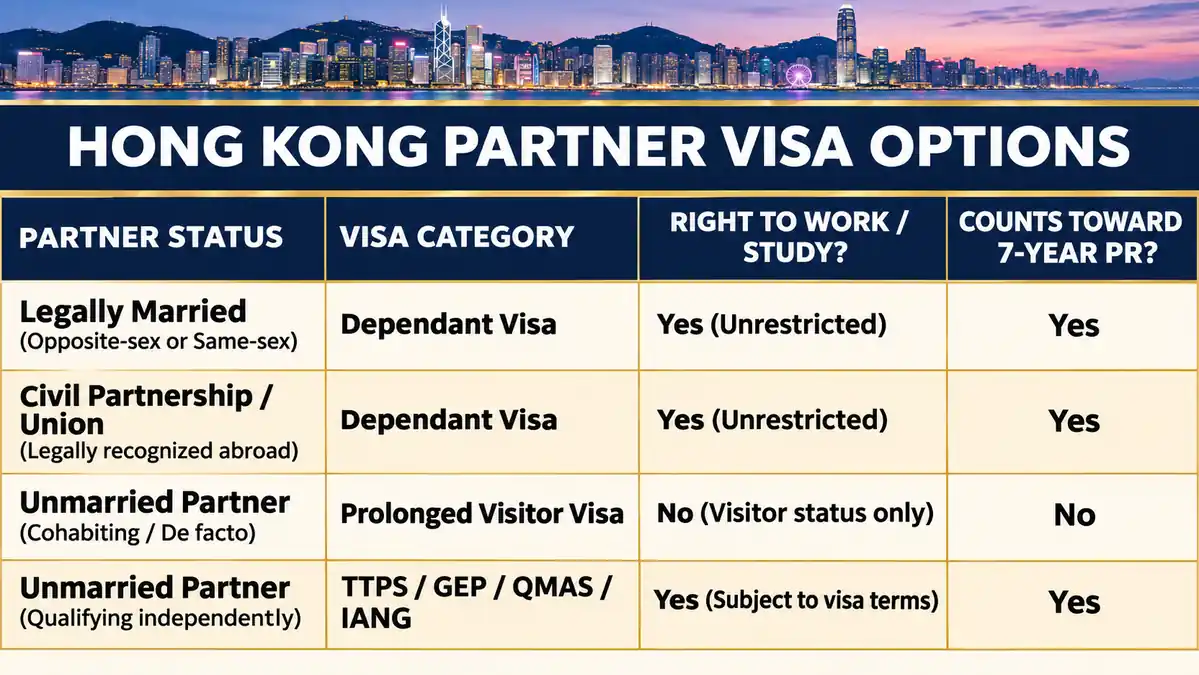
Summary Comparison for Trailing Partners
| Partner Status | Visa Category | Right to Work / Study? | Counts Toward 7-Year PR? |
| Legally Married (Opposite-sex or Same-sex) | Dependant Visa | Yes (Unrestricted) | Yes |
| Civil Partnership / Union (Legally recognized abroad) | Dependant Visa | Yes (Unrestricted) | Yes |
| Unmarried Partner (Cohabiting / De facto) | Prolonged Visitor Visa | No (Visitor status only) | No |
| Unmarried Partner (Qualifying independently) | TTPS / GEP / QMAS / IANG | Yes (Subject to visa terms) | Yes |
This old post deals with navigating Hong Kong immigration, highlighting how marriage simplifies the process and exploring options for unmarried partners
Hong Kong Visa Options Exist For Unmarried Partners? Under Hong Kong immigration policy, if you’re married, life is pretty much plain sailing from a visa perspective.
Married spouses accompanying their partners to the HKSAR when they come to work secure dependent visas which effectively provide carte blanche approvals to engage in any kind of activity which is lawful, eg, study, work, or establish a business.
However, if there is no legal marriage, the options are really very limited and the following classes of visa can be considered as a means for trailing partners to accompany their loved one to Hong Kong.
You can consider:
Getting a job offer – and then applying for an employment visa in your own right but there are no special privileges available to trailing partners in these circumstances and the approvability test for such work visa permissions is still very onerous.
The Quality Migrant Admission Scheme – if your partner is a top notch talent, representing human capital which would manifestly attractive to Hong Kong in your own right.
If you have 10 million Hong Kong dollars to invest – in certain financial assets which you are prepared to lock into the HKSAR for the life of your residency this will provide the visa permissions you need to be with your partner and, after 7 years, you can release these funds finally and secure an alternate long stay immigration status freeing up your invested capital for other uses.
Start your own business – if you have the means and experience, you can consider the business investment visa.
Study at university – if you have the desire and means, you can secure a student visa and, upon graduation with a graduate or post graduate degree, you can automatically join the Hong Kong work force under the special privileges afforded under the Immigration Arrangements for Non-local Graduates.
Alternatively, if you have been living together immediately prior to relocating to Hong Kong, you can make an application for a prolonged visitor visa on the basis that you are defacto spouses (both heterosexual and same sex partners.)
However you should consider such immigration permissions as a slippers and pipe visa as it will allow you both to remain together, but not provide the consent of the HKID to work, join in a business or take up any course of study.
VisaGeeza.Ai – Making Hong Kong Immigration A Lot Easier

VisaGeeza.Ai – 13 Years In The Making
Check Out VisaGeeza.Ai
All Our Know-How : All Our Experience : Fully Interactive
100% FREE!
More Stuff To Help You Along
Hong Kong Visa Information, Help And Guidance Now Available On Your Smartphone – 100% Free!
Please select the social network you want to share this page with:

The Hong Kong Visa Geeza (a.k.a Stephen Barnes) is a co-founder of the Hong Kong Visa Centre and author of the Hong Kong Visa Handbook. A law graduate of the London School of Economics, Stephen has been practicing Hong Kong immigration since 1993 and is widely acknowledged as the leading authority on business immigration matters here for the last 24 years.

