


PRACTICE UPDATE: A Major Strategic Shift: The Upgraded Assessment Regime for Hong Kong’s Investment as Entrepreneur Visa
Posted in Investment Visas, Musing, The Hong Kong Visa Geeza /
A Major Change: The Upgraded Assessment Regime for Hong Kong’s Entrepreneur Visa
“The era of ImmD ‘let’s see what happens’ discretion is dead. Under post-April 2026 administrative practice, the Immigration Department has replaced narrative flexibility with an uncompromising high-expectation of ‘substantial’ contribution to the economy of Hong Kong. For independent business founders, securing an Investment as Entrepreneur visa or extending a Top Talent Pass visa on a self-employed footing requires enterprise-scale corporate set up deployed from day one. Outside accredited government incubators like Cyberport or HKSTP, relying on phased hiring promises or lean, low-overhead setups almost certainly will lead to a refusal.”
— Stephen D. Barnes, The Hong Kong Visa Geeza
Over the past three and a half decades of advising on Hong Kong immigration jurisprudence and administrative practice, our firm has observed numerous regulatory cycles, administrative refinements, and policy calibrations. Across that thirty-five-year continuum, the Immigration Department (ImmD) has routinely adjusted its scrutiny to match broader macro-economic priorities. However, the comprehensive policy overhaul codified and systematically enforced since April 2026 marks what is undeniably the most consequential, structural upgrade to the General Employment Policy (GEP) – Investment as Entrepreneur framework in modern history.
For prospective founders, international investors, and corporate executives evaluating commercial ventures in the territory, the threshold of eligibility has ceased to evaluate prospective economic intent. In its place stands an exacting assessment regime founded upon immediate, verifiable, and institutional-grade operational substance.
The TTPS Category A Benchmark: Redefining Entrepreneurial Substance For Approval
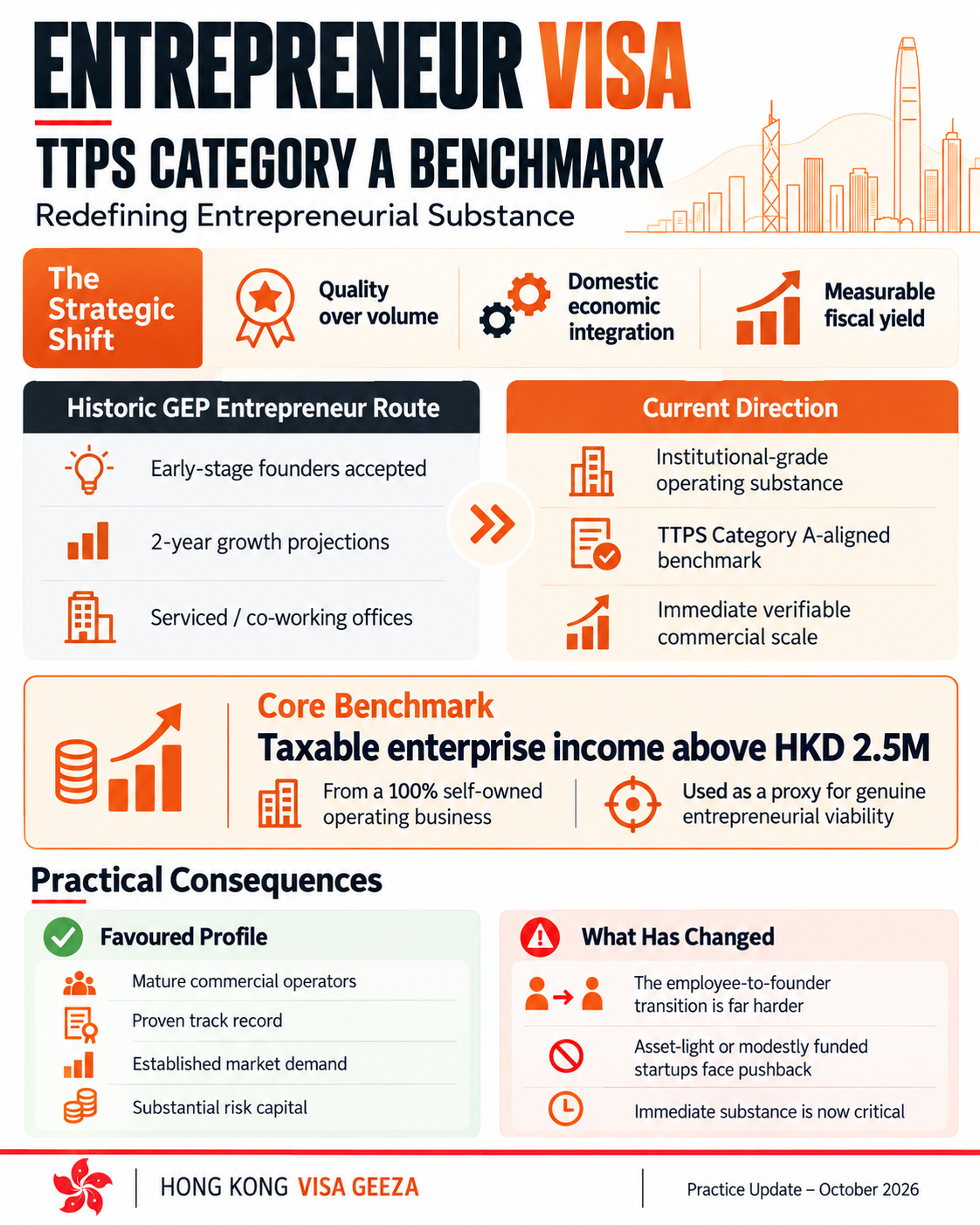
To understand the departmental mechanics driving this policy shift, one must examine ImmD’s broader economic talent strategy. Following several years of expansive talent acquisition through special visa mechanisms, the administration has pivoted toward quality, domestic economic integration, and measurable fiscal yield.
Historically, the GEP Entrepreneur route accommodated early-stage founders who incorporated a standard private limited company, submitted a well-researched two-year business projection, leased a serviced office or flexible co-working facility, and obtained initial entry clearance based on prospective expansion. ImmD case officers routinely took a measured commercial view, giving viable founders runway to prove their concept locally.
That discretionary leniency has ended. Today, ImmD has effectively aligned its internal assessment standards with the economic substance benchmark codified under Category A of the Top Talent Pass Scheme (TTPS).
Under the TTPS Category A rubric, applicants qualify on the basis of generating taxable enterprise income exceeding HKD 2.5 million derived from 100% self-owned, operating commercial enterprises. ImmD now utilizes that operational scale and financial baseline as an administrative proxy for what constitutes genuine entrepreneurial viability in Hong Kong. In the eyes of adjudicating officers, a business generating that tier of verifiable commercial activity represents the baseline profile of an entrepreneur capable of making a “substantial contribution to the economy of Hong Kong.”
The operational consequences of this alignment are profound:
Targeted Institutional Profiles: The framework is specifically engineered to accommodate mature commercial operators possessing demonstrable track records, established market demand, and substantial risk capital.
The Elimination of the “Employee-to-Founder” Transition: First-time entrepreneurs—most notably foreign professionals currently residing in Hong Kong on standard GEP employment visas seeking an in-country “change of visa category”—face an exceptionally steep barrier. The longstanding tradition of mid-career corporate executives resigning from sponsored employment to launch boutique advisory firms, consultancies, or asset-light ventures on modest startup capital is no longer viable. Applications lacking immediate, substantial capital deployment and institutional footprint are receiving immediate administrative pushback and summary requisitions.
What It Now Takes To Get Approved
While statutory provisions under the Immigration Ordinance remain formally unchanged, administrative practice has hardened across every primary assessment metric. Analysis of recent approvals and requisitions handled by our practice demonstrates that case officers now expect tangible economic infrastructure to be fully operational prior to final visa endorsement.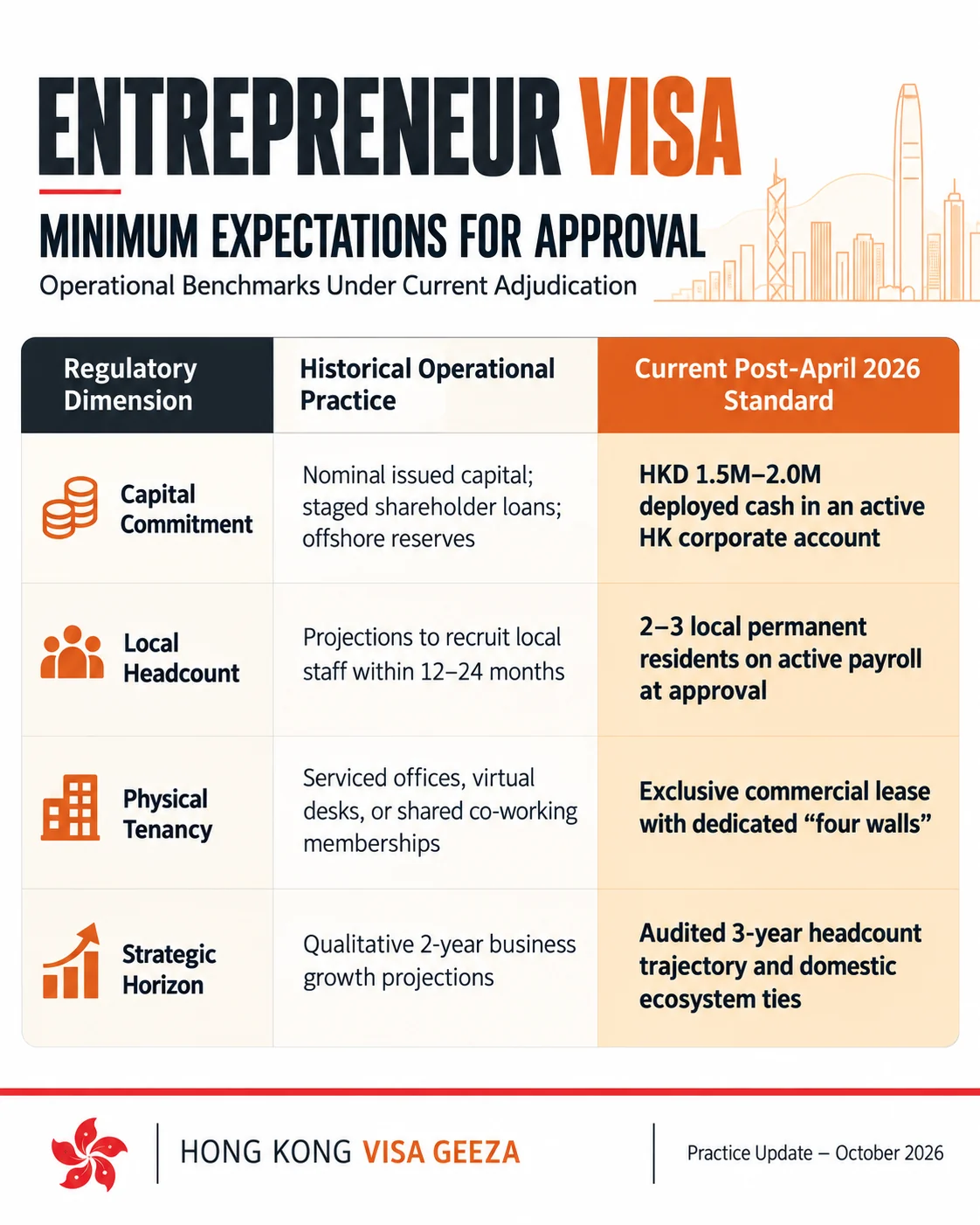
1. Immediate Capital Deployment (HKD 1.5M to 2M Deployed)
Pledges of future capital injections, nominal issued share capital, or offshore bank statements demonstrating personal liquidity are no longer accepted as proof of capability. Adjudicating officers require unencumbered capital—typically between HKD 1.5 million and HKD 2 million—to be fully remitted into a functional Hong Kong corporate banking facility. Furthermore, applicants must document actual operational expenditure drawn from these funds (e.g., fit-out costs, deposits, retained service providers, technology infrastructure) alongside verifiable cash reserves sufficient to sustain operations for the initial visa term.
2. Immediate Local Job Creation (2 to 3 Roles Operational)
The departmental expectation has shifted from future recruitment promises to immediate local employment. Case officers no longer treat local hiring as an aspirational milestone dependent on downstream profitability. Approvals now consistently require 2 to 3 full-time local Hong Kong permanent residents to be formally contracted, actively drawing market-rate salaries, and enrolled in Mandatory Provident Fund (MPF) contribution schemes prior to the finalization of the application. Models relying on offshore outsourcing or remote contractor arrangements face formal inquiries regarding why the entity requires an on-the-ground presence in Hong Kong.
3. Dedicated Physical Commercial Substance (“Four Walls”)
The era of launching an eligible Hong Kong venture from a flexible co-working desk, hot-desking facility, or serviced address without physical demarcation has effectively drawn to a close. ImmD requires tangible commercial substance: an executed commercial lease granting exclusive physical possession—verifiable “four walls”—commensurate with the proposed industry and scale of operations. Officers frequently request floor plans, lease instruments, photographic evidence of signage, and commercial utility records to confirm that the space is not shared or temporary.
4. Expanded Multi-Year Growth Trajectories
Business projections submitted to the department must cover an expanded three-year operational horizon backed by defensible unit economics. The business plan must articulate sustainable, incremental additions to the local workforce across Years 2 and 3. ImmD expects the enterprise to function as an active employer of local talent rather than a closed-loop owner-operator vehicle.
5. Verifiable Integration with Local Commercial Ecosystems
Case officers conduct detailed forensic evaluations of the applicant’s domestic business network. ImmD expects to see executed vendor contracts, operational relationships with domestic financial institutions, local client retainers, and integrated domestic supply chain logistics. Commercial entities configured purely as brass-plate conduits for cross-border offshore invoicing without domestic operational roots are subject to rigorous scrutiny.
Strategic Guidance for Prospective Applicants
Hong Kong continues to maintain its historical advantages as an international financial centre, offering low corporate tax rates, common law stability, and strategic access to regional markets. The jurisdiction remains receptive to foreign direct investment and high-caliber commercial enterprise. What the administrative apparatus has definitively eliminated, however, is accommodation for under-capitalized, highly speculative, or lifestyle ventures.
For enterprise founders seeking to establish eligibility under the GEP Investment regime, several strategic measures should guide preparation:
Pre-Fund the Hong Kong Entity: Establish an active corporate banking relationship and execute necessary equity transfers well ahead of submission. The presence of cleared, deployed capital is non-negotiable.
Formalize Local Employment Structures: Identify and contract qualified local personnel early. Ensure complete regulatory compliance across Employment Ordinance contracts, MPF enrollment, and statutory employee compensation insurance.
Secure Dedicated Tenancy: Factor commercial leasing costs directly into the initial capitalization model, bypassing serviced memberships in favor of private commercial space.
Evaluate Government-Supported Startup Alternatives: For early-stage technology founders who lack the capital reserves to satisfy the GEP standard directly, designated government-backed incubation schemes—specifically those administered by Cyberport or the Hong Kong Science and Technology Parks Corporation (HKSTP)—remain a viable strategic path. Ventures endorsed by these recognized programs continue to benefit from expedited departmental review under distinct, tailored facilitation policies.
The assessment regime for Hong Kong’s Entrepreneur visa has transformed fundamentally. Founders must structure their applications not as aspirational proposals, but as fully mobilized, institutional enterprises ready for departmental audit from day one.
Extensions of Stay Under the Investment as Entrepreneur Visa Policy
Historical Context: Discretionary Case Reviews and Commercial Flexibility
Historically, as set out by the Hong Kong Visa Geeza in A Major Strategic Shift: The Upgraded Assessment Regime for Hong Kong’s Investment as Entrepreneur Visa, formal applications for an extension of stay under the General Employment Policy (GEP) entrepreneur stream were evaluated through the flexible exercise of administrative discretion. An initial grant of stay—traditionally issued for 12 to 24 months—was conditioned upon an eventual business review by the Immigration Department (ImmD). In that era, case officers assessed commercial progress holistically under the statutory “substantial contribution to the economy of the HKSAR” test. If an enterprise had not met its initial revenue targets, delayed local recruitment, or pivoted its trading model due to standard market friction, ImmD routinely granted further periods of stay (typically on a 2-2-3 year pattern). As long as the applicant demonstrated genuine operational continuity, maintained sufficient operating capital to support ongoing overheads, and submitted a credible forward-looking commercial narrative, extensions were processed with pragmatic leniency.
Current ImmD Practice: Substantive Business Review and Verification of Contribution
Under current administrative practice, the scope of qualitative discretion applied at extension has narrowed significantly. ImmD treats each extension application as a strict evidentiary review of the enterprise’s bona fides and demonstrable economic contribution. Officers require documentary evidence establishing that the business has progressed beyond preparatory arrangements into an active, self-sustaining commercial concern. To satisfy the Director of Immigration upon renewal, an un-incubated business must provide:
Certified Financial Standing & Commercial Solvency: Submission of audited financial statements, certified management accounts, and Inland Revenue Department (IRD) Profits Tax returns demonstrating verifiable turnover and legitimate commercial transactions.
Capital Adequacy & Solvency: Verifiable corporate bank records establishing that the company maintains sufficient cleared liquidity to service ongoing operational liabilities without relying on speculative future cash flows.
Physical Business Establishment: A stamped, executed commercial tenancy agreement for dedicated business premises, accompanied by site photographic evidence and utility records, demonstrating an authentic physical place of business (co-working desks, virtual addresses, and residential home-offices face acute administrative skepticism).
Local Headcount Creation: Proof of direct employment of local Hong Kong permanent residents, evidenced by continuous Mandatory Provident Fund (MPF) contribution schedules, formal employment contracts, and direct salary payment records covering the preceding limit of stay.
Operational Baseline: Extension Refusal and the Termination of Lawful Status
Failing to substantiate these operational benchmarks at the point of extension leads to an unfavorable determination by ImmD. The Department provides no informal extensions or bridging visas for dormant, speculative, or commercially inactive corporate vehicles. If an extension of stay is refused, the applicant’s conditions of stay expire, terminating lawful residence in the HKSAR and requiring immediate departure from the territory. This departure severs the continuity of lawful ordinary residence, extinguishing the underlying legal basis for long-term settlement.
Accompanying Family: Dependant Visas and Sponsor-Linked Vulnerability
Dependant Status and Family Reunion
An entrepreneur holding an approved GEP investment visa enjoys clear sponsorship rights to bring accompanying immediate family members to Hong Kong. Under Section 11 of the Immigration Ordinance (Cap. 115) and standard departmental dependant policy, a primary visa holder who demonstrated adequate financial resources and suitable accommodation could sponsor their legal spouse (or same-sex civil partner) and unmarried dependent children under the age of 18. Accompanying family members received matching limits of stay tied to the sponsor’s visa. Dependants enjoyed full statutory freedom to engage in lawful employment, establish businesses in their own right, or enroll in primary, secondary, and tertiary educational institutions without requiring individual permissions from the Director of Immigration. Family settlement was thus viewed as an organic personal corollary to the sponsor’s commercial activities.
Current ImmD Practice: Derivative Status and Collateral Revocation
Under current ImmD practice, the administrative standing of accompanying family members remains strictly contingent upon the principal sponsor’s ongoing compliance and the continued validity of their permission to stay:
Absolute Derivative Status: Dependants hold no autonomous or standalone right to reside in the HKSAR. Their presence in the territory is legally dependent upon the principal applicant continuously satisfying the statutory conditions governing their own permission to remain.
Collateral Refusal: If the principal sponsor’s extension of stay is refused—whether due to an inadequate commercial footprint, failure to retain local staff, or depleted corporate capital—the adverse decision applies collaterally across the entire family unit. The extension applications of the spouse and children are refused simultaneously.
Abrupt Loss of Lawful Stay: Upon refusal, all accompanying dependant permissions are extinguished concurrently. The spouse’s legal entitlement to work in Hong Kong terminates immediately, children must withdraw from educational institutions, and the entire family unit is issued identical departure requirements.
Operational Baseline: Household Settlement vs. Ongoing Enterprise Viability
Advising entrepreneurial families requires accounting for this linked exposure. Operating a marginally capitalized business in the territory carries direct household risk. Maintaining compliance—including dedicated commercial tenancies, continuous MPF payments for local staff, and clear corporate auditing—is not merely an ongoing business requirement; it is the sole legal basis preserving the family’s lawful right to live, study, and remain in Hong Kong.
Pathway to the Right of Abode (Permanent Residency) After 7 Years
PR: The 7-Year Continuous Ordinary Residence Standard
Progressing from an Investment as Entrepreneur visa to the Right of Abode (ROA) after seven years was regarded as an achievable, predictable path. Under Section 2(4) of the Immigration Ordinance and paragraph 2(a) or 2(b) of Schedule 1 to the Ordinance, a non-permanent resident who has entered Hong Kong lawfully and resided as a bona fide resident for a continuous period of not less than seven years is entitled to apply for verification of eligibility for a permanent identity card (Form ROP145). In that era, entrepreneurs who held uninterrupted permissions to stay over seven consecutive years—even across low-overhead consulting entities or single-director operations—routinely secured permanent residency. As long as the applicant had paid basic Salaries Tax, maintained a domestic tenancy, and avoided continuous overseas absences exceeding six months without explanation, ImmD accepted that the applicant had established Hong Kong as their place of permanent residence.
ImmD Practice: Review of Ordinary Residence and Settlement
Securing the Right of Abode through Form ROP145 triggers an exhaustive retrospective audit by ImmD’s Right of Abode Section, scrutinizing both the applicant’s physical presence, lawful residence and manifestly objective settlement in Hong Kong:
Continuous Ordinary Residence: Under settled common law principles (such as Director of Immigration v. Kwok Chi Hung), ordinary residence requires that Hong Kong be the individual’s habitual and primary home, adopted for a settled purpose. ImmD inspects travel records across the full 84-month qualifying window. Extended periods outside Hong Kong (generally absences exceeding 180 consecutive days) require formal justification showing that the absence was temporary, intended for business purposes, and did not signify an abandonment of Hong Kong as the principal home.
Settlement: ImmD requires comprehensive documentary proof of genuine domestic settlement. Adjudicating officers examine continuous residential leases or property ownership, utility bills, domestic banking records, children’s local school attendance records, and personal tax returns (Salaries Tax demand notes and personal assessments issued by the IRD).
Breaking Continuous Ordinary Residence
The primary administrative hazard in the 7-year progression is the risk of an unbroken chain being severed. Under the Immigration Ordinance, if an entrepreneur’s extension of stay is refused at any point during the seven-year progression – whether in Year 3 or Year 6 – or if lawful permission lapses, the applicant ceases to be lawfully resident. If the continuity of ordinary residence is broken, the statutory seven-year clock will almost certainly reset to zero. All previous qualifying years are extinguished, destroying the applicant’s accumulated status and permanently closing the pathway to unconditional stay and the Right of Abode. Continuous compliance across each renewal cycle is therefore mandatory to reach permanent settlement and thereby qualify for the right of abode.
More Stuff You May Find Useful or Interesting
Successfully Apply For An Entrepreneur Visa In Hong Kong
Historically, as published by the Hong Kong Visa Geeza in How to Successfully Apply For an Entrepreneur Visa in Hong Kong, this foundational blueprint advised foreign founders that establishing an approvable business under the General Employment Policy (GEP) rested on qualitative credibility, narrative clarity, and commercial intent. Under the prevailing discretionary paradigm, the Immigration Department evaluated applications holistically. An articulate applicant could satisfy the statutory “substantial contribution” test by committing modest seed capital of a few hundred thousand Hong Kong dollars to fund early runway, securing an affordable desk in a serviced office or co-working space, and submitting a standard two-year business projection that promised to hire local staff incrementally over a phased ramp-up period as trading developed.
Under the upgraded post-April 2026 administrative regime aligned with Top Talent Pass Scheme (TTPS) Category A operational substance, ImmD has discarded speculative two-year runway forecasts and aspirational recruitment promises in favour of an immediate, binary hardware audit. Un-incubated applicants can no longer rely on narrative business models or asset-light launch plans. Adjudicating officers now mandate the upfront deployment of HKD 1.5 million to HKD 2.0 million in unencumbered corporate liquidity held in a local Hong Kong business bank account, an executed commercial tenancy for exclusive premises with dedicated “four walls” (expressly disqualifying co-working suites and serviced desks), active MPF payroll contributions for two to three full-time local Hong Kong permanent resident employees operating on-site from inception, and a defensible three-year business projection rooted in verified domestic unit economics. Lacking this deployed physical and financial hardware on day one results in swift, summary refusal.
Hong Kong Entrepreneur Visa Application Guide In A Nutshell
Historically, as published by the Hong Kong Visa Geeza in Hong Kong Entrepreneur Visa Application Guide In A Nutshell, this practical procedural summary reassured prospective founders that there was no explicit statutory financial minimum required to secure an Investment as Entrepreneur visa. The advice instructed applicants that capitalization simply needed to be sufficient to cover the initial launch and the first two quarters of operating runway. ImmD case officers exercised broad, holistic discretion, permitting lean founders to conserve working capital, operate flexibly from shared incubators or serviced business suites, and outline a high-level two-year operational roadmap where local hiring remained an aspirational downstream milestone tied to future profitability.
Under the current administrative practice, the assertion that there is no explicit financial threshold has been rendered completely obsolete by the departmental adoption of the TTPS Category A fiscal baseline (benchmarked against an enterprise capacity of HKD 2.5 million). ImmD has eliminated qualitative leniency for un-incubated applicants: capitalizing merely two quarters of operational expenses is summarily rejected as underfunded. Founders must now demonstrate fully realized, deployed liquidity of HKD 1.5 million to HKD 2.0 million deposited into a functional Hong Kong corporate banking facility, an exclusive commercial tenancy agreement for dedicated private premises, and immediate payroll registration with active MPF contributions for two to three local permanent resident staff. Without this enterprise-grade hardware firmly established prior to visa endorsement, independent applications face guaranteed refusal.
Hong Kong Investment Visa – The 3 Legs of the Application Approvability Stool
Historically, as published by the Hong Kong Visa Geeza in Hong Kong Investment Visa – The 3 Legs of the Application Approvability Stool, the approvability architecture was explained as an interdependent, three-legged stool comprising capital investment, local job creation, and substantial economic contribution. In that era, the three elements were assessed flexibly and qualitatively in the round. A founder who was light on upfront capital could successfully offset that deficit by bringing high-concept professional expertise, proprietary intellectual property, or specialized trade connections, while committing to create local jobs over a phased two- to three-year ramp-up period from an agile, serviced office base.
Under the post-April 2026 enforcement framework, the flexible three-legged stool has hardened into an unbending, pre-conditioned hardware audit where each prong must be fully operational on day one. ImmD no longer permits applicants to balance weak capital deployment with impressive personal resumes or asset-light consulting models. The capital leg requires HKD 1.5 million to HKD 2.0 million in cleared, unencumbered liquidity deposited into a local commercial bank account; the job creation leg requires two to three full-time local permanent residents already enrolled in statutory MPF schemes and drawing market-rate salaries; and the economic contribution leg demands an executed, dedicated commercial tenancy (“four walls”) integrated into the local supply chain. Failure to satisfy every single leg with verified, physical hardware results in immediate application failure.
How To Get A Hong Kong Entrepreneur Visa (The Catch-22)
How to read in light of current ImmD policy:
Historically, as published by the Hong Kong Visa Geeza in How To Get A Hong Kong Entrepreneur Visa (The Catch-22), this strategic guidance tackled the classic immigration dilemma: how an entrepreneur can take the preparatory steps necessary to establish a business without unlawfully working on a visitor visa or breaching prior employment conditions of stay. The Geeza historically advised applicants to lodge their investment application right at the threshold of inception, using proposed business plans, preliminary incorporations, and conditional commitments to secure approval before substantive commercial trading commenced, thereby navigating the Catch-22 safely and lawfully within ImmD’s discretionary latitude.
Under modern adjudication standards, filing an early-stage, aspirational proposal at inception is an immediate recipe for summary refusal. ImmD now strictly refuses to approve un-incubated business plans that lack deployed operational reality, creating a severe operational paradox for foreign founders. Because case officers demand verified hardware on day one—including an executed commercial lease, HKD 1.5 million to HKD 2.0 million in local corporate liquidity, and active local payroll with MPF contributions—founders cannot establish these facts in-country as visitors without risking prosecution for unlawful employment under Section 41 of the Immigration Ordinance. This regulatory trap can now only be bridged either by mobilizing institutional-scale corporate infrastructure remotely through authorized local nominees or by securing formal admission into an accredited government incubator (such as Cyberport or HKSTP), which remains the sole statutory safe harbor exempt from the day-one hardware audit
Hong Kong Investment Visa for an Unprofitable Company – Easy or Hard?
How to read in light of current ImmD policy:
Historically, as published by the Hong Kong Visa Geeza in How Easy (Or Hard) Is It For A Second Foreign National Business Partner To Get A Hong Kong Investment Visa For An Unprofitable Company?, this case analysis evaluated whether a foreign partner could secure an entrepreneur visa to join an existing Hong Kong corporate entity that had not yet achieved profitability. Historically, ImmD evaluated such applications through holistic commercial discretion. If the applicant could demonstrate that their joining would inject fresh working capital, introduce valuable domain expertise, or implement a turnaround plan that would steer the business toward profitability and phased job creation over the subsequent two years, case officers were willing to grant approval despite historical trading losses.
Under the contemporary assessment regime, attempting to sponsor an incoming foreign entrepreneur into an unprofitable, un-incubated business based on prospective turnaround narratives is essentially futile. Aligned with TTPS Category A financial benchmarks, ImmD treats ongoing unprofitability as a red flag indicating a lack of commercial viability. Case officers will summarily reject the application unless the sponsoring entity can independently prove that it already possesses enterprise-scale stability: an active, exclusive commercial office tenancy, two to three local permanent resident employees continuously maintained on full-time MPF payroll, and unencumbered corporate liquidity of at least HKD 1.5 million to HKD 2.0 million dedicated to sustaining the business without relying on speculative future cash flows. Outside accredited incubation programs, narrative rescue plans are disregarded; the hardware must be fully deployed and verifiable.
VisaGeeza.Ai – Making Hong Kong Immigration A Lot Easier

VisaGeeza.Ai – 13 Years In The Making
Check Out VisaGeeza.Ai
All Our Know-How : All Our Experience : Fully Interactive
100% FREE!
Please select the social network you want to share this page with:

The Hong Kong Visa Geeza (a.k.a Stephen Barnes) is a co-founder of the Hong Kong Visa Centre and author of the Hong Kong Visa Handbook. A law graduate of the London School of Economics, Stephen has been practicing Hong Kong immigration since 1993 and is widely acknowledged as the leading authority on business immigration matters here for the last 24 years.

